We know that to improve the anti-interference capability of communication systems, RS485, CAN bus, USB, and Ethernet interfaces all use differential signal transmission. Differential transmission is a signal transmission technique that differs from the traditional single-signal-line approach. Differential transmission transmits signals through two lines, with these two signals having equal amplitudes but opposite phases. The signals transmitted on these two lines are called differential signals. A differential signal uses a numerical value to represent the difference between two physical quantities. Differential signals are also called differential-mode signals, as opposed to common-mode signals. Figure 1 shows the transmission waveforms of the V+ and V- differential signals on the signal lines and the data analysis waveforms at the receiving end.
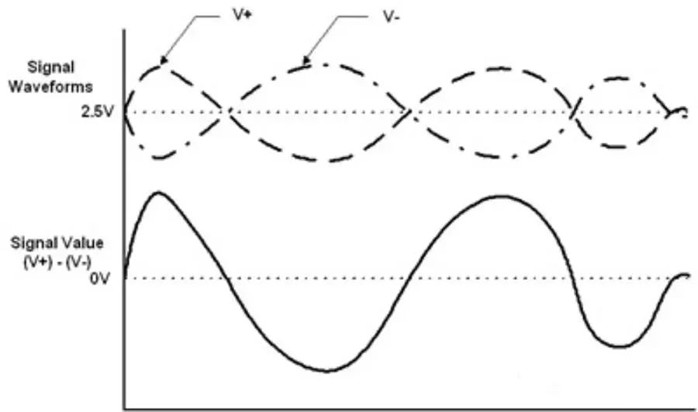
Figure 1. Differential signal waveform
When we use differential signaling for transmission, although it increases the complexity of any related interface circuits, it offers the following three advantages:
1. Because you are controlling the 'reference' voltage, small signals can be easily identified. In a single-ended signal system using ground as a reference, the accuracy of the measured signal depends on the consistency of the 'ground' within the system. The further the signal source and receiver are from each other, the greater the possibility of differences in their local ground voltage values. The signal value recovered from a differential signal is largely independent of the precise value of the 'ground';
2. It is highly immune to external electromagnetic interference (EMI). An interference source affects each end of the differential signal pair to almost the same extent. Since the voltage difference determines the signal value, any identical interference appearing on both conductors will be ignored. Besides being less sensitive to interference, differential signals generate less EMI than single-ended signals;
3. In a single-supply system, it can easily and accurately handle 'bipolar' signals. To handle bipolar signals in a single-ended, single-supply system, we must establish a virtual ground at some arbitrary voltage between the ground and the power supply rail (usually the midpoint). Voltages above the virtual ground represent positive signals, and voltages below the virtual ground represent negative signals. Then, the virtual ground must be correctly distributed throughout the system. With differential signaling, such a virtual ground is not needed, allowing us to process and transmit bipolar signals with high fidelity without relying on the stability of the virtual ground.

Xml Privacy Policy Blog Sitemap
copyright @ Micro-Magic Inc All Rights Reserved.
 Network Supported


 English